How 205 villages, 120 women in Kendrapara (of 300 across Odisha), and a mangrove forest learned to live with each other, and what it teaches the rest of India.
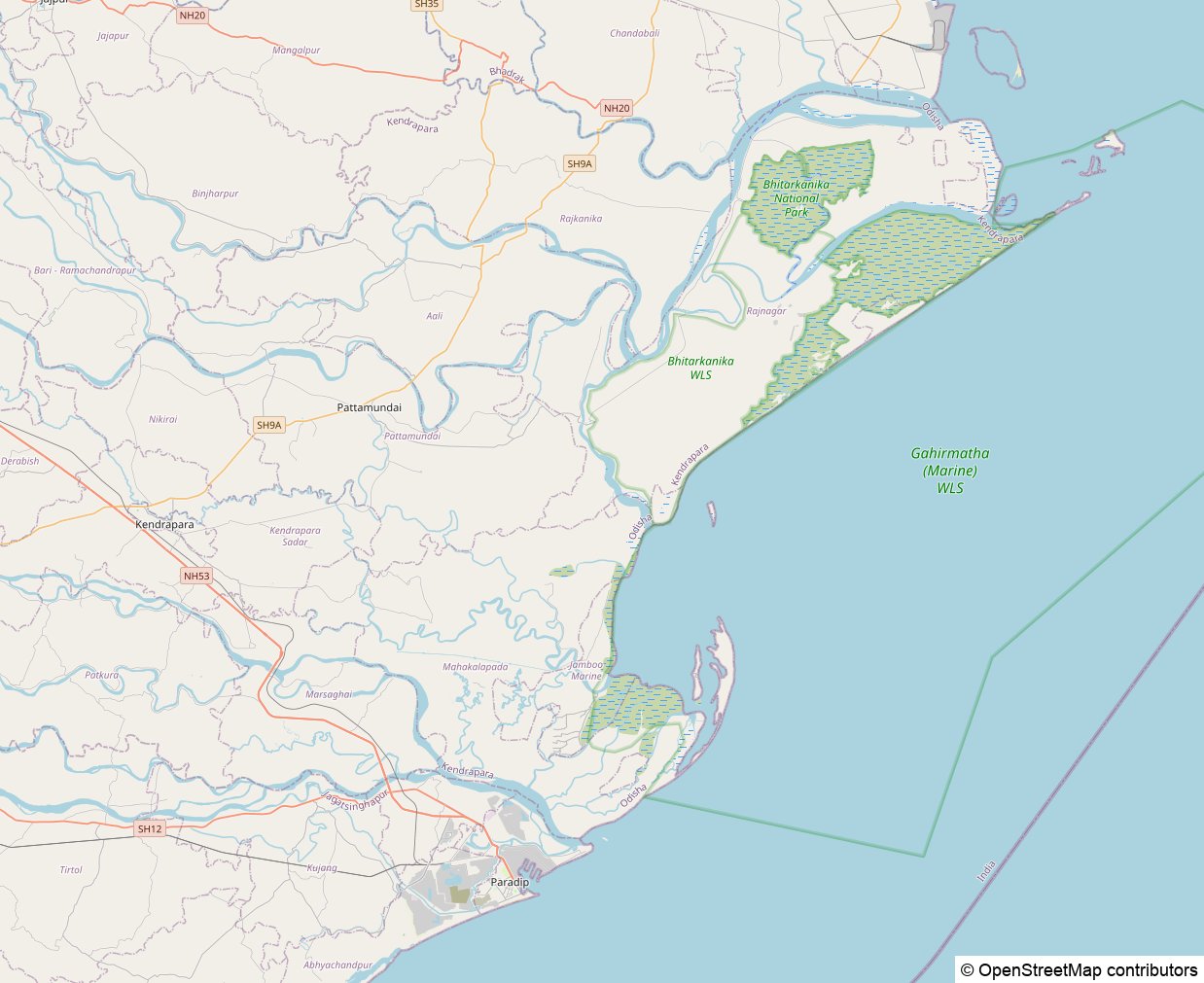
Rainmatter Foundation initiated the Kendrapara Sandbox in 2023, in collaboration with 17 partner organisations, anchored locally by Socratus Foundation with Nature's Club. Kendrapara was the proving site: a coastal delta caught between the Brahmani, Baitarani and Dhamra rivers (with Mahanadi distributaries, Birupa, Chitrotpala, bounding the district to the south), holding the Bhitarkanika mangroves on one side and the rising sea on the other. This is the story of what happened when systemic, place-based interventions met community ownership over two years.
Our work at the Foundation has been guided by the core need of making places thriving for all beings to exist in harmony. Three principles shape every Sandbox:
Why it matters: when people in a place make choices thinking holistically, the place becomes thriving for everyone.
Every number in this case study lives in one of the four quadrants below. Each figure appears once, here, the rest of the page tells you how it was built, what it replaced, and what it returns. Deltas as badges.
Per-household ranges (quadrant 02) are indicative, drawn from typical Odisha producer-group economics (NRLM, NABARD, ICAR-NRRI). Carbon figures use mid-range mangrove sequestration rates (Donato et al. 2011 · Sanderman et al. 2018 · IPCC 2013 Wetlands Supplement) and 2024–25 voluntary-market prices; coastal-protection range uses the Costanza et al. (2014) per-hectare framework. Audited valuations require project-level registration. Full sourcing in the Sources section.
From a Foundation point of view, identifying leverage points that can be used to build an implementation architecture is what makes a place-based approach travel. Kendrapara had four:
120 Climate Champions already organised (primarily SHG members) through Enhancing Climate Resilience of India's Coastal Communities (ECRICC, UNDP) across 400 villages. A ready cadre beyond just state-enabled SHGs and FPOs.
Nature's Club, a local NGO, already acting as a "place" anchor and operating with 17 partner organisations (WellLabs, Socratus Foundation, SELCO, Goonj, Odisha Forest & Environment Department, UNDP, Kendrapara District Administration, among others).
Programmes already on ground that could be plugged into: ECRICC, Mangrove Pathotsav, Kendrapara@2036.
Political and government openings to scale through: District Convergence Action Plan (DCAP), Kendrapara Vikas Mela (ORMAS), BAGAPATIA DPR (NABARD), UNDP-ECRICC, Agriculture Department's Crop Diversification Programme, and OSDMA.
Kendrapara is a coastal delta district shaped by the Brahmani, Baitarani, and Dhamra rivers, with Mahanadi distributaries, Birupa and Chitrotpala, bounding it to the south. It holds the Bhitarkanika mangrove ecosystem, one of India's most cyclone- and salinity-vulnerable geographies, and is overwhelmingly rural, informal, and agrarian, paddy, pulses, fisheries.
By area, Kendrapara is the centre of mangrove India in Odisha. The latest forest reports place ~212 sq km of mangrove cover inside the district, roughly 81% of the 259 sq km across Odisha's five coastal districts (Kendrapara, Jagatsinghpur, Puri, Bhadrak, Balasore). Nested around it sit the Bhitarkanika Ramsar wetland (~650 sq km) and the Wildlife Sanctuary (672 sq km, with a 145 sq km National Park core). Over the past four years, Kendrapara's mangrove cover grew by ~9.43 sq km, out of ~9.89 sq km for all of Odisha. Nearly every hectare the state added, it added here, largely through the fishbone-channel restoration model and CAMPA-funded work.
Job-linked migration is a defining feature. Kendrapara is often called the plumber capital of India, its men leave for cities and, increasingly, for the Middle East. Behind them, women hold the land. The district carries a rich political past as Biju Patnaik's constituency, and has long been a focus of Odisha's coastal resilience programmes, pond rejuvenation, mangrove restoration, women-led adaptation.
The Sandbox set out to test a single question: can Kendrapara become a model for ecosystem-based rural resilience, blending conservation, livelihoods, and community leadership into something that holds?
The first move was not a programme, it was deep sensemaking. Goonj's Gram Swabhimaan approach was deployed in a DIY format, with the process handed to community representatives who recontextualised it for Kendrapara. The question shifted from "What is wrong here?" to "What is happening here, really?"
Repeated cyclones, saline intrusion, and erosion eating the coast and the land it holds.
Traditional agriculture and fishing turning unviable, driving seasonal and distress migration. Kendrapara now exports plumbers to the Middle East.
Mangroves and water bodies, once integral to local identity, were now being read primarily as threats.
Multiple government schemes existed, but with limited local convergence and no clear ownership at the village level.
Listening was operationalised. Goonj's Gram Swabhimaan template was adapted into a DIY worksheet handed to Climate Champions, who profiled each village across eleven dimensions of life. The deep diagnostic ran across 43 villages in two coastal blocks, Bhitarkanika and Mahakalpada, while lighter engagement (events, peer networks, producer-group convening) reached the wider 205 across nine blocks. Each dimension produced not a number, but a story.
Number of households per habitation, the unit on which every downstream calculation rests.
Rice, fishing, daily wage, migration, mushroom, vegetables, what people actually do for money.
Ponds, tubewells, bamboo, Nalia grass, date palm, the natural and built capital a village can draw from.
Saline vs. non-saline tables, drinking-source distance, rejuvenation needs for canals and ponds.
Crocodile encounters, wild boar, monkeys, abandoned bulls, what's threatening crops and bodies.
Rice, pulses, vegetables, what grows, what fails, what's already been tried.
Cattle, goats, poultry, ducks, who keeps what, and for whom.
Who leaves, where to, for how long, doing what. Kendrapara's "plumber capital" data lives here.
What training has reached the village, what's still missing, what people would attend tomorrow.
Where the village already produces something a buyer might want, the seed of any livelihood plug-in.
An open field. The most important one, where surprise enters the dataset.
Over 300 women across Odisha, 120 in Kendrapara, were trained as Climate Champions under the ECRICC programme (UNDP, March 2025), through a 30-hour curriculum delivered as three one-day workshops. They adopted resilient farming practices, led mangrove replantation drives, and passed knowledge through peer networks. The unit of change became the woman, not the project.
Alongside the Champions, 20 local Mentopreneurs were trained to support producer groups on value chains, green entrepreneurship, and climate-resilient livelihoods. A Mentopreneur is a first-generation entrepreneur rooted in local realities, working with SHGs, producers, and community players, and acting as the first point of contact between solution providers and the response ecosystem for technology, innovation, and research.
SHGs, youth clubs, and panchayat representatives formed the operational nucleus, engaging in Citizen Juries, Climate Recipe exhibitions, and Gram Swabhimaan dialogues. Abstract consultations turned into tangible community voice mechanisms.
The narrative around mangroves shifted from fear to friendship. Mangroves stopped being obstacles to be cleared and became allies, flood protection, honey, crab farms, identity.
Nature's Club, a Kendrapara-based NGO, evolved into the anchor institution, holding space for external collaborations while keeping the ecosystem locally governed. The orchestrator stayed inside the place.
The Sandbox worked because no single actor tried to own it. Grassroots stewards led; civil society held the scaffolding; government and global partners brought weight and finance; local media carried the story.
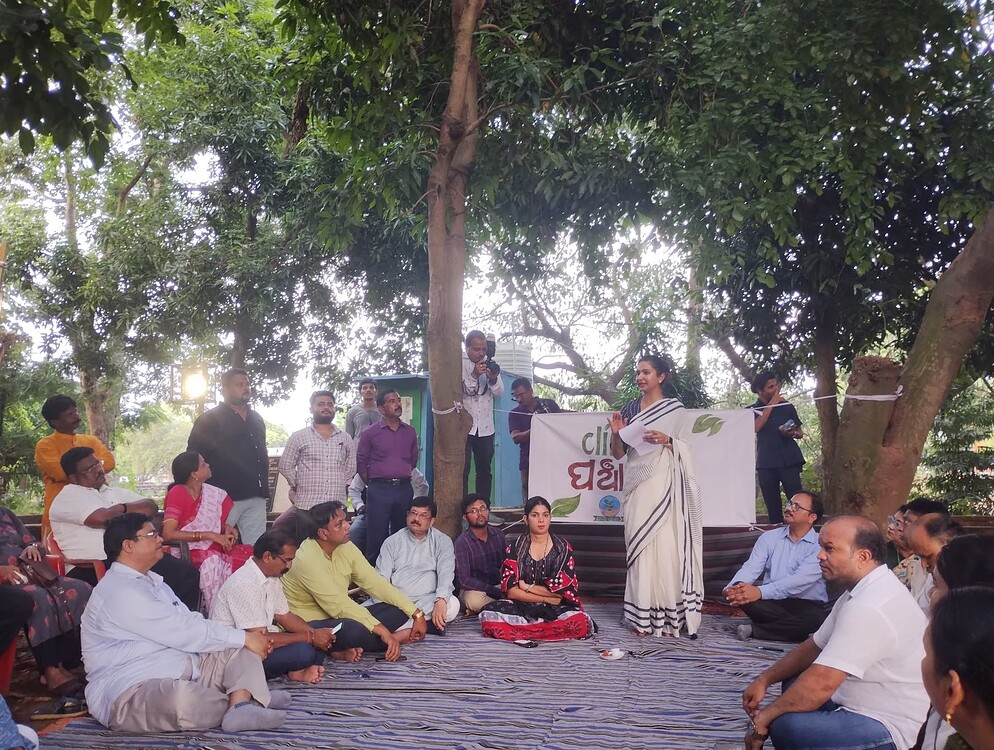
State-level convening with 100+ researchers, scholars, scientists, ECRICC, media, and CSO actors on mangrove ecology, economy, and species coexistence. Partners: Sambad Media Group, Bakul Foundation, XIM University, MLAs.
Expanded public understanding through youth-led curated platforms (GirlsZen Jury and INNOENVIRON 2025), convened by Ramadevi University and Human Development Foundation.
Showcasing a flourishing Kendrapara vision in the era of climate change, with all converging departments, policymakers, and a footfall of ~1 lakh people.
A 3-day clinic with WELL Labs, engaging 60+ farmers, women entrepreneurs, and FPO members on green-economy plug-ins and value-chain design.
Convened for demands linked to government schemes; positioned #Kendrapara2036 as a district-level climate vision through senior political-leadership engagement.
Partnered with Nature's Club to mobilise communities on bioregional economy and climate-smart energy solutions.
The four categories below are not categories invented for a report, they are the four questions the village itself was already asking, in its own words, on its own porches. The funnel only gives the questions a shape that government, civil society, and solution providers can also read. Nothing was filtered for sounding correct; everything was sorted for who could carry it.
A demand surfaces, through Gram Swabhimaan, the Village Assessment Survey, the Climate Champions Cohort, or events like Mangrove Patha Utsav.
Sorted by who must act: Individual, Community, Collective, or District Administration. The category determines the path.
A single demand explodes into its components. "Mangrove plantation" becomes ten distinct units of work, each a separate brief.
Each component is matched to a solution provider, drawn from the GRE Network, Sandbox partners, line departments, or marked "to be onboarded."
Programmes do not travel; their components do. Once a demand is unpacked, each component becomes a self-contained plug-in, small enough to be lifted, replicated, or remixed by a neighbouring district without inheriting Kendrapara's particular weather or politics. The funnel produced 94 such plug-ins, split roughly evenly between two landscapes. A selection from each is below.
47 plug-ins · Kendrapara reference
47 plug-ins · transferable beyond the coast
The cumulative on-ground progress across enterprise plug-ins is represented through two umbrella brands and a set of agritech and FPO market-linkage partnerships.
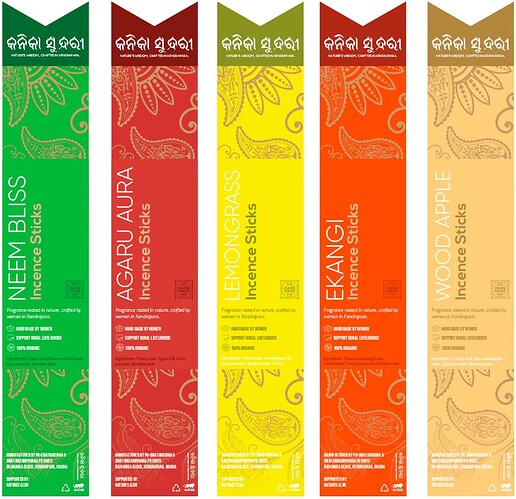
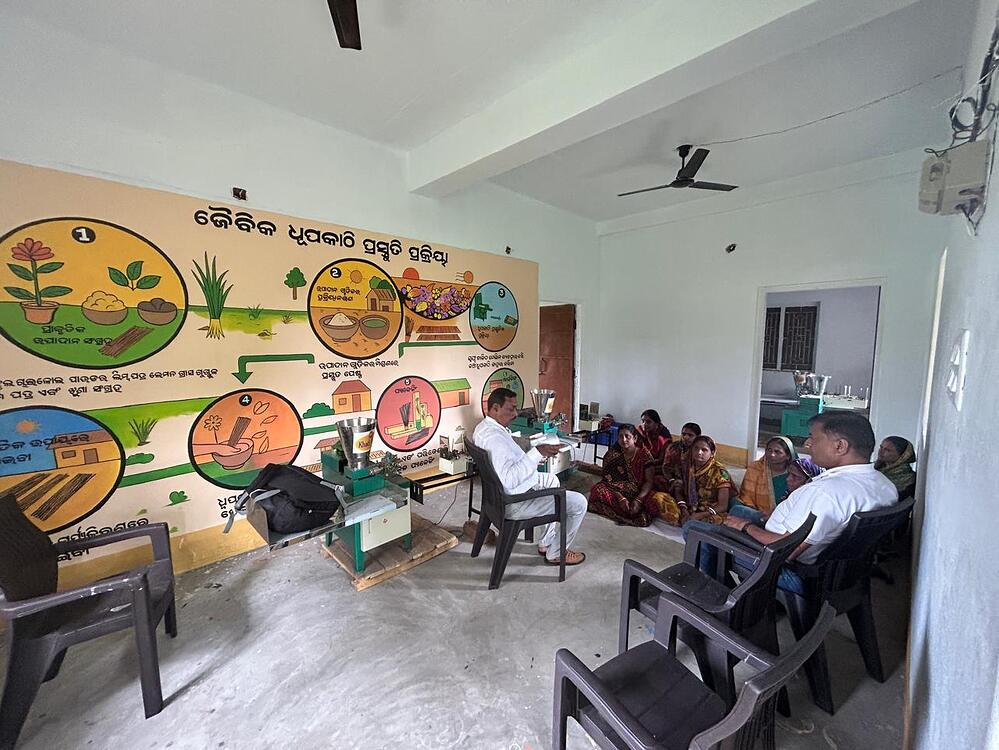
"Nature's Wisdom, Crafted in Kendrapara." Covers organic agarbatti (3 producer groups, 150+ women, ITC offtake contracted), nalia handicraft (1,000 families, 5 villages), mushroom (45 SHGs), azolla (5,000 growers), tailoring (7 clubs, 150 women), and organic inputs (5,000 families).
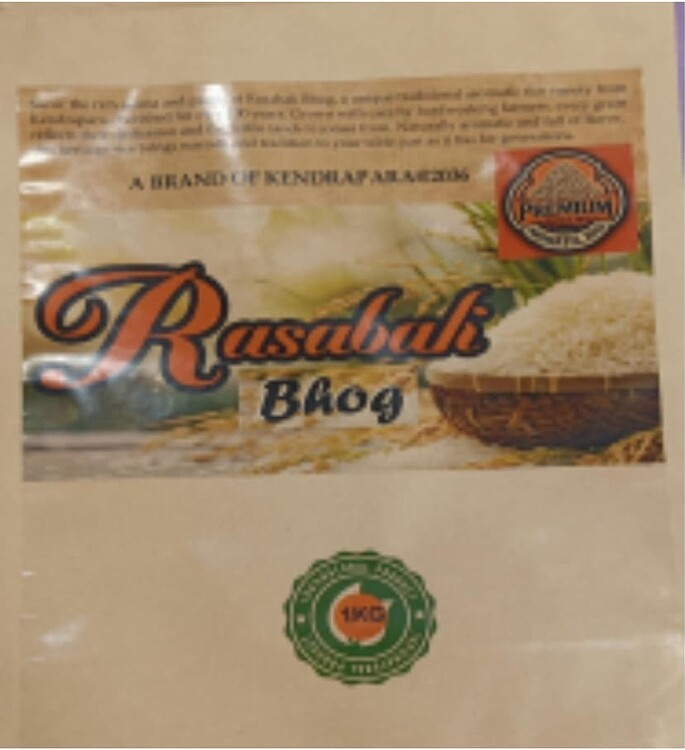
The aromatic organic rice value chain, anchored on Leelavati, Kendrapara's local rice variety, packaged for market under the Rasabali Bhog brand. Connects 84-village saline-resistant rice work (7,000+ farmers) to consumer-facing premium retail.
Market linkage with Villamart, a farm-to-fork agritech startup in Odisha, roped in via the Bhubaneswar City Knowledge Innovation Cluster (BCKIC) Foundation, an initiative of the Office of the Principal Scientific Adviser (PSA).
Partnership with Cocoter Farms, an agritech startup providing end-to-end solutions for commercial integrated coconut farming, as the technical and resource partner for the Integrated Pond Liner Fish Farming initiative in Bagapatia under the Amrit Sarovar Scheme (MoRD).
Sandbox work did not stop at producer groups and plug-ins. It moved through party manifestos, the Odisha Assembly floor, and the secretariat, converting community signal into political and institutional infrastructure.
Mainstreamed climate into political parties' manifestos in Odisha, making it an electoral issue, not just a policy one.
Hyperlocal climate discourse where MLAs raised ground-truth issues (salinity, mangrove loss, heat stress) from the floor of the Odisha Assembly.
Positioned as a district-level climate vision through engagement with senior political leadership, anchored in the District Convergent Action Plan (DCAP).
Under VOCGA, Socratus co-curated a Climate Finance panel with Sambad and Bakul Foundation, charting Odisha's green-finance roadmap with experts and policymakers.
Viksit Odisha Climate Governance Authority: a proposed state-level body to coordinate climate action across departments, currently in deliberation with the Government of Odisha.
Developed with CEEW, the framework formally links ecology and economy as joint outcomes, providing a measurement spine for the Sandbox model.
A committee of converging department Secretaries, chaired by the Development Commissioner, formed to action the CEEW Common Results Framework across schemes.
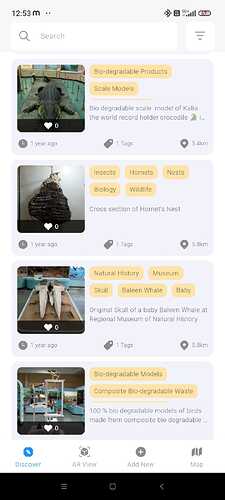
Launched December 2024 as a species repository of mangroves and associated species, built with artisans, fishers, Climate Champions, CSOs, and government stakeholders to apply local knowledge for livelihoods and conservation.
A rough first-order estimate of the funds and economic value mobilised through Sandbox activity across ecology, livelihoods, and government scheme convergence. Indicative for planning purposes, not audited.
| Line item | Basis | Value |
|---|---|---|
| Mangrove restoration | 53 ha × ₹2.5 lakh / ha | ₹1.25 Cr |
| Creek rejuvenation | 17 km at Julusnagar · irrigation for 5,000+ farmers × ₹5,000 / farmer / yr | ₹2.50 Cr |
| Pond rejuvenation | 200 community ponds · Viksit Gaon scheme | ₹2.00 Cr |
| Place-based livelihoods ecosystem | ~20,000 households · agriculture, crafts, circular economy, SHGs · one-time annual identify/train/implement | ₹18–20 Cr |
| Bhitarkanika development | Department of Forest & Environment | ₹20.00 Cr |
| DCAP funds unlocked | Pond rejuvenation, Nalia Cluster, OLM livelihood, Horticulture, Aquaculture schemes | ₹2.00 Cr |
| Total value unlocked | ~₹50 Cr |
Funding context. Much of this work was enabled by the presence of Climate Champions, who were part of the UNDP–GCF ECRICC coastal resilience programme (~US$130M for 2019–2027, across 24 coastal ecosystems in 12 districts spanning Andhra Pradesh, Maharashtra, and Odisha) and were leveraged as an on-ground cadre for the various Sandbox initiatives.
Real insight comes from community sensemaking, not from sector frameworks parachuted in. The diagnosis must belong to the place.
How → Train Climate Champions to run the 11-dimension Gram Swabhimaan worksheet as a guided conversation (not a survey); commit every entry to a shared master sheet so each village has a living description of itself, accessible to anyone who arrives later.
Changing local narratives, mangrove as friend, not threat, builds intrinsic motivation. Behaviour follows belief, not incentive.
How → Stage cultural moments (Mangrove Patha Utsav, Climate Recipe exhibitions, citizen juries) that reframe the resource publicly; produce short films, reels, and local-media features so the new framing travels at the speed of WhatsApp, not the speed of a report.
Facilitation models like Nature's Club ensure continuity across funding cycles. The orchestrator must live in the place.
How → Designate one locally-rooted organisation as the orchestrator; route partner contracts, payroll, and convening through it; give it decision rights, not just facilitation duties, so it can hold the place across funding cycles.
Iterative prototypes, Azolla, mushroom, Nalia, Agarbatti, enabled adaptive scaling. The portfolio grew because no single bet had to carry the place.
How → Run multiple plug-ins as parallel 6-month sprints, each with a defined kill-switch and a producer-group lead; double down on the two or three that take traction; prune the rest without ceremony and feed the learnings back to the master sheet.
Bottom-up innovation influenced formal systems, ECRICC, the District Administration, the Forest Department. Community work travels when government carries it.
How → Map each plug-in to a state scheme (CAMPA, MNREGA, GPDP, ECRICC, Mangrove Mitra) before it scales; co-brand pilot outcomes with the District Collector; convert pilot data into convergent action plans for the next budget cycle so the work travels on government rails.
The Sandbox was a two-year proof. What follows is the scaling architecture, sequenced across near-, mid-, and long-term horizons.
The Kendrapara Sandbox evolved through iterative, community-led experimentation, mapping, co-designing, celebrating, transferring ownership. Fragmented efforts became a scalable, locally sustained climate resilience model. The delta is learning to live with itself.
For any team adopting this approach in a new place, what we used, how we sorted, and what every column on the master sheet means.
| Column | Meaning | Allowed values |
|---|---|---|
| Landscape | Which of two reference landscapes the demand belongs to. | Coastal · Rural |
| Demand discovered | The community's framing, kept in their words wherever possible. | Free text (e.g., "Pond rejuvenation") |
| Category of demand | Which actor must lead, and therefore where the brief lands. | Individual · Community · Collective · District Administration |
| Source of demand | Which listening instrument surfaced it, for traceability. | Gram Swabhimaan · Village Assessment Survey · Climate Champions Cohort · Mangrove Patha Utsav · others |
| Components unpacked | The plug-in level, the actual units of work. | Numbered list (1, 2, 3 …) |
| Status | Where each component is in the linkage funnel. | Solution provider onboarded · To be onboarded |
| Source of solution provider | Which network the provider was drawn from. | GRE Network · Sandbox Partner |
Mangrove area, protected-area, and growth figures are drawn from government forest data and reporting; carbon and ecosystem-service estimates use peer-reviewed mangrove literature with rupee conversions at 2024–25 voluntary-market and shadow-price ranges; livelihood and programme numbers come from Rainmatter Foundation field data and partner records.
A working appendix of organisations, products, platforms, and political moments that shaped the Sandbox. Each exhibit is a record, not a summary.
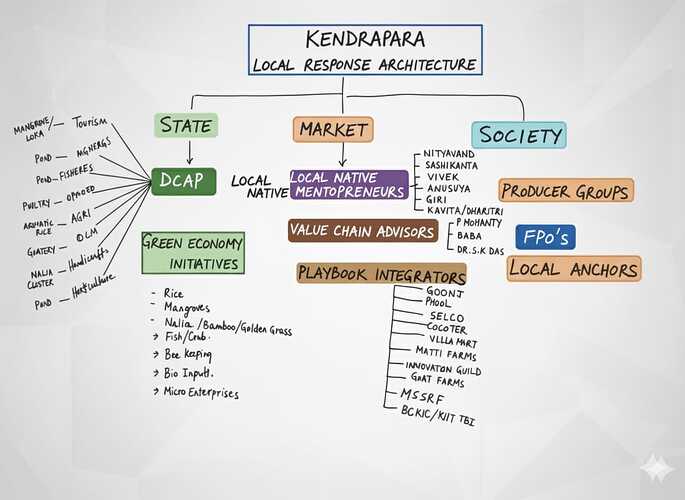
The full Sandbox architecture, hand-mapped. State (DCAP, Green Economy Initiatives), Market (Local Native Mentopreneurs, Value Chain Advisors, Playbook Integrators), and Society (Producer Groups, FPOs, Local Anchors) interconnect through Nature's Club. Names visible on the diagram: Goonj, Phool, SELCO, Cocoter, Matti Farms, Innovation Guild, Goat Farms, MSSRF, BCKIC/KIIT TBI.
Organic agarbatti product line from the 150+ women producer collective, ITC offtake contracted, market-ready under the Kanika Sundari brand.
Kendrapara's local rice variety Leelavati, packaged for premium retail under the Rasabali Bhog brand, anchoring the 84-village saline-resistant rice value chain.
Launched December 2024 as a species repository of mangroves and associated species, built with artisans, fishers, Climate Champions, CSOs, and government stakeholders.
Climate Panchayat session held in Barabati Constituency, led by Hon'ble MLA Sofia Firdous. A working session converting ground-truth climate evidence into Assembly-floor questions.
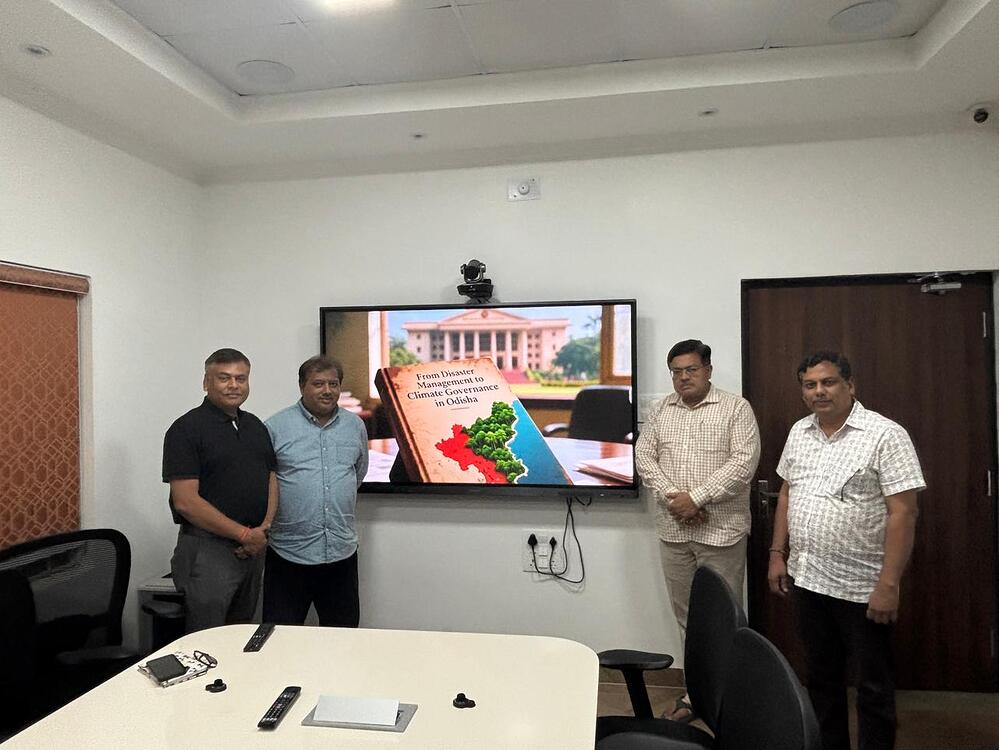
Meeting with Hon'ble Minister Prithviraj Harichandan, Government of Odisha, deliberating the establishment of the Viksit Odisha Climate Governance Authority (VOCGA).
Product research and development centres focused on nature-based and bio products: the scaling spine for value-chains beyond pilot scale.